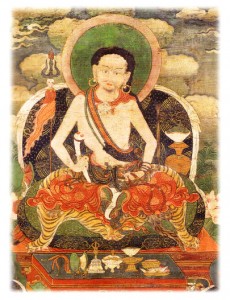
 The Tiger Seat
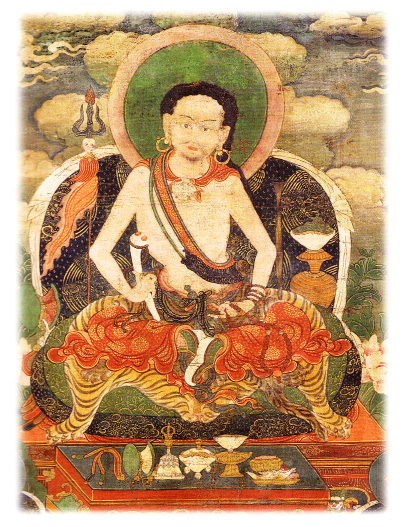
Animal Skins
Animal skins, whether sheep, yak or carnivorous beast, have been used for survival from the elements, comfort, convenience and status since humans could hunt or domesticate animals. They were a ready source of material for creating clothing, dwellings and furnishings. Skins and furs form a natural mat or rudimentary carpet, and have been used in this way from prehistory up to our present technological age. Thus the use of skins as a meditation seat also goes back to earliest times. However, they acquired quite a new purpose, meaning and symbology in the context of Vajrayana. Indeed, wild animal hides formed an intrinsic part of the tantric lifestyle and accoutrements of the wandering yogis and yoginis of ancient India. Dorje Trollo, the wrathful emanation of Padmasambhava, rides a tiger as his consort and Dombi Heruka, the great mahasiddhi, is also depicted in this iconic form. In fact a number of the legendary 84 Mahasiddhis are typically portrayed seated on animal skins, including Virupa and Bhayani (depicted on the left). The migration of the Secret Mantra Path to Tibet also brought numerous tantric implements, instruments and specialized forms of dress, and the animal skin seat was readily adopted. Milarepa, like many other great saints of India and Tibet, is traditionally shown sitting on a deer or antelope pelt, and even Sakya Pandita (shown below) is shown in yogic pose on a tiger skin\’”and wielding a bone kangling!
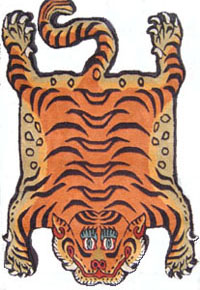
The Woven Rug
Rugs in Tibet were numerous and essential parts of nomadic, village and monastic lifestyles. They were portable, warm, and also became a sign of status and wealth. With tribal Central Asian, Indian, Chinese influences and especially Buddhist influences, a unique Tibetan style of carpet developed. Meditation rugs, woven from yak wool, might typically have patterns of dorjes, auspicious symbols or other dharmic themes. But for the yogi, and particularly the chopa, the wild animal pelt was the preferable seat.
All the traditional texts that list the chopas tools of the trade mention the damaru, bell, kangling and tent, followed closely by the tiger seat, \’with its claws intact.\’ Tiger pelts would have been fairly plentiful and available, their natural range spreading from India and Nepal to China. Hunters or villagers eliminated animals that encroached on their territory, while the large cats still had vast uninhabited regions in which to roam free. Then, as now, in spite of the Buddhist respect for all life, hunting and meat-eating was an intrinsic part of Tibetan culture. The dwindling tiger population worldwide, and a very favorable change in human consciousness, has made the killing of these magnificent animals abhorrent to the modern mind. It is not clear when the transition to the woven wool tiger took place, but certainly the two traditions existed simultaneously, and today the tiger carpet has happily taken the place of an actual tiger pelt.
 The Meaning of the Tiger Rug
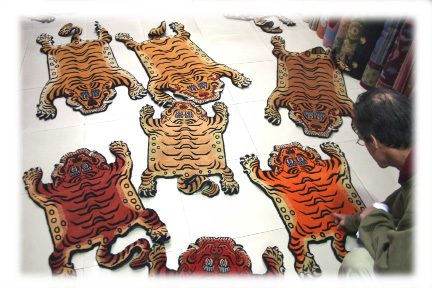
The wandering Chod practitioner or ngakpa (mantric practitioner) cared little for status or comfort, yet the tiger skin was an important possession. The tiger represents our basic passions and desires, and taking our place on such a seat proclaims our victory over the lha and dr̩, the gods and demons of the illusory world of experience and cyclic rebirth. The skin of these carnivorous beasts, who naturally and freely kill rather defenseless creatures, is also endowed with very special energies. On an outer level, the tiger gives us strength and the courage and fortitude to overcome all obstacles and behave with fearlessness. On an inner level, the wrathful, violent vibration, the karma of the desire to kill and the actual deeds performed, provide special fuel for the yogi\ժs inner meditative experience. In Chod it is the transformation of these energies, rather than their avoidance, that is the path. The yogi or yogini steps directly into these difficult energies and is forced to develop compassion and confront their own demons. On the innermost level, they help the meditator to cut through hope and fear. This is the same reason that one of the ideal type of kanglings is from the body of someone who died in battle, or through mutual slaying, and why tiger and leopard strips are used on the tail of the damaru.

Tent of 6th Dalai Lama
The Modern Rug
Tent of 6th Dalai Lama
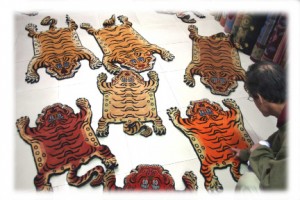
The modern tiger rug comes in a number of varieties, but the one directly related to the chopas practice are the \’cut-out rugs,\’ which mimic the shape and look of a real tiger skin. These are all hand made on the Tibetan loom, not mass-produced, so each is a work of art, craft and tradition, fabricated from yak wool, usually at 100 knots per inch. Both natural and chemical dyes are integrated, depending on availability and ease of use. Still, like any craft, the work varies significantly. The woven tiger rug links us to our past tradition, and to the transformative and challenging energy of the real tiger skin. Yet somehow, this simple carpet is more than a cartoon replica, or a compassionate substitute. Somehow they have retained a vibrant link to its living brethren.
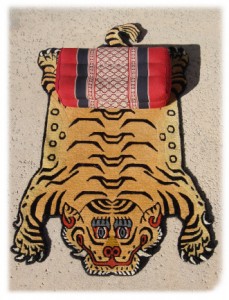 Going Tiger
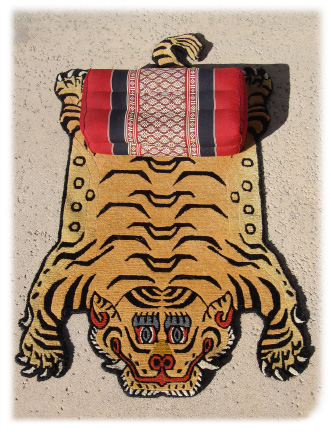
One should use this tiger rug or \’tak gyi den\’ as one\’™s main meditation seat at home, and as a portable meditation cushion for every circumstance or event to enhance one\’™s practice.
There is a wide range of quality, and since they are hand made, no two rugs are exactly the same. Like all our yogic material, these are not shipped in bulk, but hand-picked. The ones that have the best weave, expression, \’personality\’ and aliveness are adopted for their new home in the West. These rugs can be found on the internet in a few places, but we will send you a photo of your potential rug and make sure it is the one you want. On my \’tiger hunting\’ trips, I go through as many as are available, seeking those with the energetic qualities that make them fitting as a daily meditation companion and acquiring those with that seem vibrant, humorous, and absolutely alive. Like the damaru, these are effervescent and full of life force, creating sacred space and sacred view. A good tiger rug attracts many invisible helpers, dakinis and protectors. Our practice is more enjoyable, and our meditation stronger and more luminous.
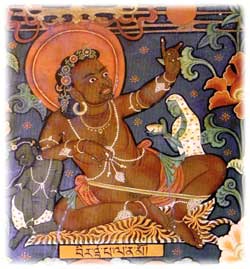
Mahasiddha Virupa
